Posts

4 Advantages of Cloud in the Healthcare Industry
advantages of cloud

4 Advantages of Cloud in the Healthcare Industry


As pandemic COVID-19 spread, the healthcare industry is increasing during this situation. According to Deloitte, people are more concerned about their health more than before, today. It can be seen by their behavior of learning about health risks and how to improve it. That’s why the healthcare industry now needs to overcome the challenge.

However, by massive people coming to healthcare, a lot of data also will be generated from it. Conventional storage definitely will not be enough to store massive data. Therefore, cloud adoption can be a solution for that. With the cloud, healthcare can optimize its data management practices. Not only that, but the cloud can also bring advantages to the healthcare industry. What are them? Read 4 advantages of cloud in the healthcare industry below:

1.     Lowering of costs 

One of the advantages of the cloud is this technology offers on-demand availability of computer resources. By this advantage, hospitals and healthcare providers don’t need to purchase other hardware and servers anymore. Besides, the cloud also provides the organization’s payment system for the resources it uses. So, it could result in massive cost savings.

2.     Ease of interoperability

When healthcare providers have a lot of patients, automatically it will generate massive data for the organizations. Therefore, healthcare needs interoperability that aims to establish data integration throughout its system. But don’t worry, the cloud could make it easy for organizations. With interoperability fueled by the cloud, patient data is readily available to distribute and facilitate healthcare planning and delivery. 

3.     Access to high power analytics

Data is a huge asset for healthcare to plan other innovations for customers. Therefore, storage like cloud computing is needed to store and process it. By adopting cloud, relevant patient data from different sources can be collated and computed. Not only that, but the implementation of Big Data analytics of patient data on the cloud-stored could also strengthen medical research. That’s why these advantages of the cloud can make data processing becomes more feasible. 

 4.     Prevent data loss

Most healthcare providers and hospitals are likely to keep medical records with physical copies. This might be a common thing for a hospital to do, yet it will cause risk like data loss. Paper records could be misplaced, become torn or faded, or otherwise damaged by the disaster. But, when an organization starts to shift its conventional storage to cloud-stored, the risk of data loss will be prevented.

By using cloud services like Backup as a Service or Disaster Recovery as a Service, the organization can replicate their data as well without any mistakes. So, healthcare providers don’t have to worry more about data loss that is caused by disaster and human error.

Zettagrid Indonesia is one of the cloud service providers of Infrastructure as a Service (IaaS) that offers Virtual Server, Virtual Datacenter, Backup as a Service (BaaS), and Disaster Recovery as a Service (DRaaS). If you have any further questions about cloud solutions, you can contact us here or at sales@zettagrid.id
Digitalize and Secure Your Finance Solutions

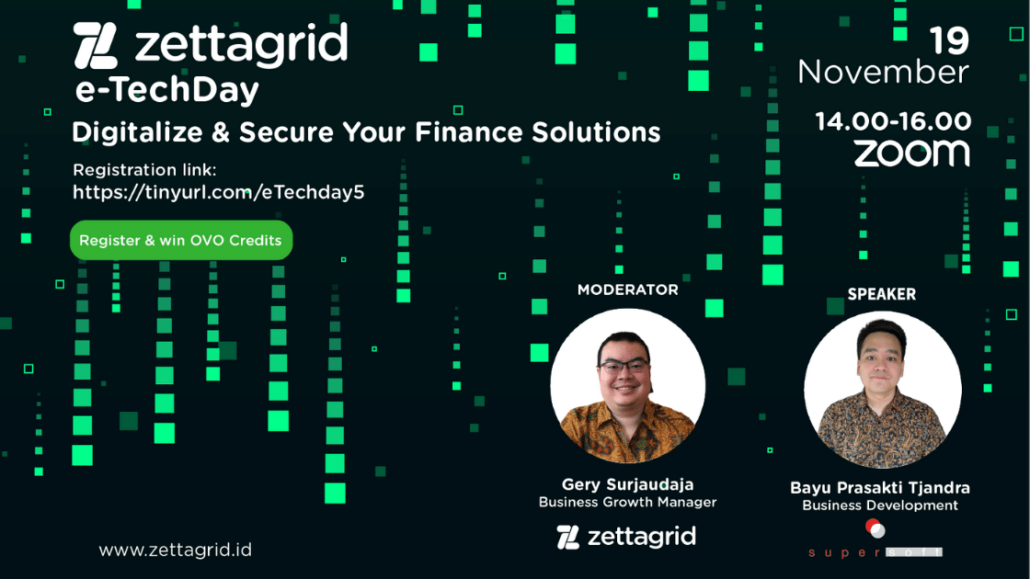
Finance SolutionDigitalize & Secure Your Finance Solutions
 

The pandemic situation that happen along 2020 brought enterprises to be more digital and flexible including its working system. Many tech provider now creating solutions for better remote working experience, especially for accounting system, one of critical part from a business.

Then how if financial system moves into digital? How is the security system from a digital accounting system?

Find the answer on “Zettagrid e-TechDay Vol.05: Digitalize & Secure Your Finance Solutions”. Meet our guest speaker Bayu Prasakti Tjandra from Supersoft, a company that will provides you IT solution including financial system software.

Event Details:

Date: Thursday, 19 November 2020

Time: 14.00-16.00

Live online from Zoom

Link to register:  https://tinyurl.com/eTechDay5

Save your spot now and get chance to win OVO credits by the end of Event. If you need further information you could contact us to marketing@zettagrid.id or click here.

Cara Meningkatkan Efisiensi Cloud Computing

Meningkatkan Efisiensi Cloud

Cara Meningkatkan Efisiensi Cloud Computing


Berbicara tentang cloud computing, anda pastinya akan mengira jika teknologi satu ini bisa menjadi solusi terbaik bagi penyimpanan data organisasi. Namun, terlepas dari beragam solusi yang dihadirkan, cloud juga mampu mendatangkan tantangan tersendiri bagi bisnis. Salah satu tantangan utama yang umum terjadi adalah masalah efisiensi.

Berdasarkan survei yang dilakukan oleh SoftwareOne, 37% responden menganggap tantangan terbesar cloud datang dari pengeluaran yang sulit diprediksi. Hal Ini mungkin wajar terjadi apabila pengguna tidak merencanakan migrasi data secara matang. Untuk itu, sekadar mengadopsi cloud sebagai tempat penyimpanan saja tidak akan cukup, jika tidak disertai dengan efisiensi yang optimal.

Namun, anda tidak perlu khawatir. Pada artikel ini, anda akan mengetahui cara yang tepat dalam meningkatkan efisiensi cloud. Simak selengkapnya di bawah ini:

  1.       Monitor cloud secara komprehensif

Cloud tentunya dapat memberi berbagai kemudahan dan kecepatan dalam mengoperasikan computing resource. Akan tetapi, kemudahan ini juga memiliki potensi yang dapat menyebabkan inefisiensi. Untuk itu, organisasi harus bisa memonitor jumlah dan penggunaan cloud secara lebih komprehensif. Sehingga, anda tidak perlu lagi mengeluarkan biaya banyak untuk kebutuhan yang tidak penting di akhir pemakaian.

  1.     Mengoptimalkan penggunaan tags

Jika anda ingin meningkatkan efisiensi cloud, anda bisa mencoba mengoptimalkan penggunaan tags untuk memonitor pemanfaatan cloud. Tags ini umumnya bisa mencakup banyak hal, seperti menunjukkan sebuah data kerja sedang diproduksi atau tidak, waktu kadaluarsa data kerja yang tengah dikerjakan, hingga departemen mana yang bertanggung jawab atas data kerja yang disimpan di cloud tersebut. Jadi, data yang disimpan di cloud pun bisa lebih terstruktur dan pengusaha bisa memprediksikan biaya yang akan dikeluarkan.

  1.     Memaksimalkan otomasi

Saat awal proses adopsi, pengelolaan cloud secara manual relatif mudah dilakukan. Namun ketika adopsi semakin membesar dan melibatkan multi cloud provider, ada baiknya organisasi harus segera melakukan otomasi. Dengan melakukan hal tersebut, pengusaha bisa memonitor dan mengoptimasi biaya penggunaan cloud. Tak hanya itu, pengeluaran besar yang tidak terduga pun bisa dihindari, sehingga penggunaan cloud pun bisa lebih efisien.

  1.     Gunakan pendekatan teknis 

Dalam memanfaatkan cloud, pengusaha membutuhkan pendekatan teknis dan proses bisnis yang tepat. Untuk mencapai hal itu, Gartner menyarankan framework yang terdiri dari lima langkah, yaitu plan, track, reduce, optimize, dan mature. Lima langkah tersebut bertujuan untuk memperkirakan anggaran yang dibutuhkan dalam mengimplementasikan cloud. 

Jadi, ketika proses berjalan, pengusaha bisa memonitor pengeluaran dan membandingkannya dengan dana organisasi untuk menghindari anomali yang terjadi. Setelah itu, organisasi bisa mengurangi setiap pemborosan yang terjadi dengan melakukan optimisasi. Untuk itu, langkah ini bisa menjadi jalan bagi pengusaha jika ingin meningkatkan efisiensi cloud secara maksimal.

Jika anda memiliki pertanyaan lebih lanjut terkait pemanfaatan cloud, anda bisa menghubungi kami di sini atau melalui tim kami di sales@zettagrid.id.

Tips Meningkatkan Keamanan Data Cloud

Meningkatkan Keamanan Data

Tips Meningkatkan Keamanan Data Cloud 


Saat mengembangkan bisnis, anda pastinya membutuhkan teknologi yang dapat membantu menciptakan inovasi terbaru bagi pelanggan. Cloud bisa menjadi salah satu solusi untuk menjawab kebutuhan tersebut. Dengan cloud, pengusaha dapat meningkatkan infrastruktur IT secara lebih optimal. Tak hanya itu, cloud juga dapat mengubah investasi anda dari biaya CapEX yang amat besar menjadi OpEx, sehingga anda dapat menghemat biaya investasi infrastruktur IT anda.

Namun, tahukah anda? Meski cloud telah memberikan berbagai kemudahan, bukan berarti data yang tersimpan di dalamnya dapat terjamin dengan aman. Menurut penelitian yang dilakukan oleh 1000 IT di Skotlandia, hampir 60% di antaranya masih belum mempercayai sistem penyimpanan berbasis cloud. Keyakinan ini muncul ketika melihat sistem cloud yang masih terbilang rentan dari serangan hacker

Untuk itu, penyimpanan data di cloud secara cuma-cuma saja tidak akan cukup untuk menjaga data tetap aman. Namun, anda tidak perlu khawatir sebab tips berikut bisa menjadi preferensi anda dalam meningkatkan keamanan data cloud. Simak selengkapnya di bawah ini:

  1. Pastikan data telah terenkripsi ketika disimpan di cloud

Tahukah anda? Ketika pelanggan mengadopsi cloud, kebanyakan cloud service provider tidak meng-enkripsi data pelanggan saat memigrasikan datanya di cloud. Untuk itu, anda perlu memperhatikan bahwa data yang akan disimpan di cloud tidak memuat informasi sensitif dan konfidensial, seperti rekam medis, data keuangan, hingga data rahasia perusahaan demi mencegah terjadinya kebocoran data. 

  1. Enkripsi data secara mandiri

Ketika anda memutuskan untuk memigrasikan data ke cloud, ada baiknya anda tidak hanya mengandalkan layanan enkripsi data dari cloud service provider. Enkripsi data secara mandiri juga perlu dilakukan agar menjaga data tetap aman di cloud. Sehingga, ketika pihak luar mencoba mendownload data bisnis anda, data telah terenkripsi dan tidak mudah diakses. Informasi penting pun tidak akan dengan mudah bocor ke kompetitor.     

  1. Ketahui cara mengoperasikan cloud

Beberapa perusahaan layanan cloud memiliki fasilitas dalam membagikan folder secara online. Anda perlu mengetahui secara detail bagaimana cara mengoperasikan fitur tersebut. Dengan demikian, anda dapat mengetahui siapa yang terakhir mengakses, mengubah, menghapus, menambah, dan membuat perubahan data di cloud.

  1. Pastikan penyedia layanan telah memiliki sertifikasi keamanan 

Ketika akan memigrasikan data ke cloud, ada baiknya bagi anda untuk memastikan apakah penyedia layanan memiliki sertifikasi keamanan seperti ISO 27001 dan Service Level Agreement (SLA). Sebab dengan dua kebijakan tersebut, anda dapat mengetahui jika penyedia layanan dapat menjamin keamanan data pelanggan dan bisnis. Sehingga, jika terjadi kebocoran data dari penyedia layanan, anda bisa melaporkannya ke pihak berwajib dan memprosesnya ke jalur hukum. 

  1. Strategi Backup data

Saat menyimpan data bisnis di cloud, pastinya anda menginginkan jaminan keamanan terbaik untuk menjaga data cloud tetap aman. Untuk itu, anda bisa menggunakan strategi backup data demi mencegah terjadinya kerusakan dan kehilangan data. Dengan strategi Backup, data-data bisnis akan direplikasi sesuai dengan data utama. Sehingga, ketika sewaktu-waktu data utama hilang, anda masih dapat mengembalikan data secara penuh.

Zettagrid Indonesia menyediakan layanan cloud computing berupa Backup as a Service (BaaS), untuk memudahkan anda dalam melakukan pencadangan. Zettagrid Indonesia juga merupakan Cloud Verified Partner dari VMware dan memiliki lokasi data center di Jakarta dan Cibitung. Kami berkomitmen untuk lebih dekat dan siap sedia membantu Anda selama 24/7. 

Jika anda memiliki pertanyaan lebih lanjut mengenai cloud, anda bisa menghubungi kami di sini atau melalui tim kami di sales@zettagrid.id.

5 Warehousing Issues You Need To Avoid

Warehousing Issues

5 Warehousing Issues You Need To Avoid


The development of digital technology has given some ease to various aspects of life. Ranging  from lifestyle, needs, even business, people now can feel the benefits of them digitally. Not only that, the digital era also created efforts that can bring innovation in various industries. One of them is by utilizing cloud computing.

Today, cloud utilization has evolved from a simple usage concept to become a technology solution in various industries. This can happen because of the flexibility, scalability and accessibility of it that give ease for an enterprise. That’s why it is not a surprise if cloud now has become a business strategy for many enterprises. Especially for enterprises that depend on their business in the warehousing field.

With a cloud-based Warehouse Management System (WMS), enterprise can avoid various warehousing issues. This was also stated by Antony Wijaya, as a Business Development at Largo, when he was a speaker at the online workshop “Zettagrid e-Techday vol. 04: Run a Cloud-based Warehouse Management System Like a Pro” on October 20, 2020. Antony explained that there are at least 5 warehousing issues that can be prevented when using a cloud-based WMS. There are: 

  1. False Distribution

When storing one type of item in large quantities at a warehouse, many enterprises certainly don’t know which item is the new one or the expired one. This will become a problem if the goods with a near expiration date are left for a long time in the warehouse. Meanwhile, goods with a long expiration time are taken out first.

That’s why, a cloud-based WMS is needed to avoid these warehousing issues. So, the goods that need to be distributed will not affect business continuity.

  1. The number of goods available cannot be expected

Sometimes, enterprises don’t know the exact amount of goods that are available in the warehouse. Although it is natural, this kind of warehousing management will be a problem if it continues. Not only that, it will also affect sales for not gaining the best results for the company. Therefore, enterprises can use a cloud-based WMS to find out the quantity of goods, so enterprises will prevent these warehousing issues and still be able to reach sales targets exactly.

  1. Items are lost and found

When storing large quantities of goods in the warehouse, usually enterprises will experience sudden loss of goods. It should be noted that the loss of an item that occurs is not caused by theft, considering that the item can be found again in an unexpected time. This is a common problem when enterprise doesn’t use cloud-based WMS. So it is not surprising that warehousing management is not neatly organized and structured. 

  1. Calculate the availability of goods manually

Today, many enterprises still use the stock opname method for counting goods. Stock opname is a form of activity to calculate the stock of goods in the warehouse before they are sold. This activity is generally wasting time, because you will manually check and calculate the items in the warehouse. 

However, with a cloud-based WMS, enterprises no longer need to do that. Only by scanning a barcode , the counting process can be done quickly and efficiently. Beside that, errors in administrative and counting goods can be minimized. 

  1. Efficiency

When enterprises manage a warehouse manually, the workforce that needs to monitor goods distribution activities definitely not a few. This will be very inefficient for the company. Thus, a cloud-based WMS is needed in this case in order to save existing resources and minimize manual warehouse operations.   

If you want to find out more about this session you can watch the online talk show again on our Youtube account here. And if you are interested in cloud solutions to support your business continuity, you can contact us at sales@zettagrid.id or click here.

Assisting Organisations In Achieving Digital Transformation In 2020

Digital transformation

Assisting organisations in achieving digital transformation in 2020

Despite the overall market conditions and the impact of a highly disrupted 2020, spending on edge computing, as a solution that will help organisations to solve many of the operational challenges that they are currently facing, is tipped to explode. GlobalData research anticipates a 22.7 per cent CAGR on global sales of edge computing infrastructure and services through to 2024.

As noted in the previous article, Capitalising on the latest trends in cloud and edge computing, the ability for edge computing to reduce bandwidth bottlenecks and minimise latency to maximise efficiency and undertake real-time data and decision processing is a stepping stone towards advanced analytics and AI applications. That makes edge computing a key cornerstone in transformation projects.

As noted in a recent KPMG report, history has shown that companies that take a strategic future-focused investment approach during times of unrest were better placed when the global economy rebounded.

“IT leaders should continue transforming their operating models and investing in key enablers, like integrated cloud platforms, agile ways of working, intelligent automation, AI, blockchain, and advanced data and analytics.”

Zettagrid, in partnership with VMware, is enabling channel partners across Australia and Indonesia to deliver edge computing and transformation without having to construct and maintain their own infrastructure. This allows the partner to work on delivering the competitive differentiation and future readiness of transformation to their customers, without incurring the massive upfront costs and logistical challenges of building infrastructure.

VMware Cloud Director and its value to the channel

Core to the success of any edge computing application is the idea of fluidity – that local resources and compute power can seamlessly and instantly interact with cloud resources, regardless of location or the types of technology being used. VMware Cloud Director is a direct response to that technology need. It provides users with access to virtual datacentres, powered by a cloud network constructed of almost 1,000 providers. This solution delivers all the expected cloud capabilities – containers, security data protection, cloud migration and operations visibility – through a fluid, hybrid cloud fabric that seamlessly integrates between all on-premises infrastructure within the customer’s organisation, as well as the cloud.

New features to the most recent iteration of VMware Cloud Director – 10.1 – include:

  • App Launchpad, which allows organisations to access Bitnami secured and tested applications via a simple to consume interface.
  • Encryption and data security. Across a suite of security tools and processes, VMware Cloud Director provides protection not only for data at rest, but also data “in flight,” as it actively encrypts data as it is being processed, which is essential when data is being constantly moved between the edge and the cloud.

For the channel, this solution will form the bedrock of a transformation and edge computing project. The multi-tenancy approach means that the pool of resources can host and serve many customers, each in complete (and therefore secure) isolation.  It’s also rapidly scalable and API-driven, meaning that the environment and usage can be tailored to the individual organisation’s needs.

Most importantly, it allows for seamless migration and the replication of on-premise infrastructure, allowing organisations to shift from traditional on-premises environments to a cloud hybrid environment effortlessly.

Addressing the challenges in transformation

What has complicated transformation projects for many channel organisations is the need to source the infrastructure necessary to deliver solutions. Needing to design and deliver datacentre solutions is a process that has excluded many channel partners from assisting their customers with their transformation exercises.

Additionally, in the current market, enterprises are risk adverse and budget constrained – they’re looking to their channel partners to provide the innovation and workstyles of a transformed business, but to also do so at predictable and reliable prices.

Partnering with Zettagrid gives channel organisations of all sizes and scales access to VMware Cloud Director and its expansive cloud infrastructure. Additionally, partners can access:

  • Local infrastructure and support, with Zettagrid covering the entire market.
  • A shift to automated billing and provisioning. While the channel partner exclusively maintains the relationship with the partner, Zettagrid’s billing system removes the administrative headache from their operations.
  • No need to maintain the environment. Zettagrid’s infrastructure provides class-leading reliability and uptime, but is maintained entirely by the Zettagrid engineers, saving the channel partner the need to resource datacentre management, upgrades, and maintenance.

The partner’s role through this disrupted and challenging time is in helping their customers to prepare for the other side and a “new normal”. This makes technology innovation and transformation a key priority. Those partners that are able to offer their customers this without taking on the risk of infrastructure investment themselves will be well placed to deliver successful projects in the current climate.

Contact us HERE if you want to join to be Zettagrid Partner or e-mail us at sales@zettagrid.id

This article was posted on: Assisting organisations in achieving digital transformation in 2020, Arnet

Tips Memilih Cloud Service Provider

Tips Memilih Cloud Service Provider

Tips Memilih Cloud Service Provider


Pada masa pandemi ini, keberadaan cloud service provider menjadi populer bagi pengusaha dari berbagai industry. Hal ini dapat dikatakan mengingat pemanfaatan teknologi cloud yang bersifat fleksibel dan efisien. Tak hanya itu, cloud juga memungkinkan pengusaha untuk bekerja dari mana pun dan kapan pun. Sehingga tak mengherankan, jika teknologi satu ini mampu memudahkan organisasi agar tetap bisa memperlangsungkan bisnisnya di masa yang tak menentu ini.

Jika Anda baru akan mulai beralih menggunakan cloud computing, pastinya Anda akan bertanya-tanya bagaimana cara memilih penyedia layanan cloud yang berkualitas?

Dalam memilih layanan cloud, berbagai aspek tentunya perlu diperhatikan oleh Anda. Meski saat ini banyak cloud service provider yang menawarkan layanan cloud computing dengan beragam keunggulan, namun ada baiknya Anda perlu mempertimbangkan hal tersebut dengan cermat dan berhati-hati demi menemukan cloud hosting yang berkualitas untuk organisasi. Sebab jika tidak sesuai, hal ini akan memakan waktu dan biaya bisnis secara cuma-cuma.

Untuk menghindari hal tersebut, simak  6 Tips Memilih Cloud Service Provider yang patut anda pertimbangkan:

  1.     Kebutuhan Organisasi

Sebagai pengguna Anda tentunya harus memiliki tujuan dalam beralih menggunakan cloud computing. Jika Anda tidak ingin menghabiskan waktu dan uang demi layanan cloud yang tidak sesuai, maka Anda perlu mengetahui lebih dalam kebutuhan dan ekspektasi Anda guna mencapai penghematan biaya. Untuk itu, Anda perlu membuat daftar tujuan terlebih dahulu, sebelum akhirnya menentukan penyedia cloud computing.

  1.     Performa Server dan Jaringan

Salah satu yang perlu diperhatikan pengusaha sebelum menggunakan cloud provider adalah dengan memperhatikan performa server atau jaringan.  Jika Anda ingin mendapatkan akses cepat ke aplikasi yang tersimpan di cloud, Anda perlu tahu lokasi aplikasi yang disimpan di end user, jaringan pada pusat data cloud, serta kecepatan antara lapisan server dengan kapasitas yang digunakan. Sehingga, Anda dapat menghitung performa cloud service provider sebelum Anda menggunakannya. 

  1.     Keamanan Data

Jika Anda hendak beralih menggunakan cloud service provider, Anda perlu memperhatikan keamanan data yang ditawarkan. Apakah cloud tersebut disertai firewalls, anti virus, multifactor user authentication, enkripsi data, dan audit keamanan secara rutin atau tidak. Hal ini sangat penting dilakukan untuk menghindari terjadinya serangan siber. Tak hanya itu, Anda juga bisa mendiskusikan mengenai kompetensi sistem disaster recovery centernya apabila hal ini dibutuhkan demi menghindari hilangnya data akibat bencana.

  1.     Service Level Agreement (SLA) 

Beberapa layanan cloud menawarkan Service Level Agreement (SLA) yang tinggi kepada pelanggan. Hal ini tentunya dilakukan untuk memberikan pengalaman layanan cloud yang terbaik. Namun pada banyak kasus, SLA hanya dihitung ketika sistem layanan cloud mengalami kegagalan, bukan saat ketersediaan layanan sedang berjalan. Untuk itu, Anda perlu menemukan cloud service provider yang dapat menjelaskan rencananya dalam memenuhi SLA kepada pelanggan untuk memastikan kompetensi layanan cloud.  

  1.     Memonitor Layanan dan Keamanan

Jika Anda beralih menggunakan layanan cloud, seluruh sistem yang Anda pergunakan akan dimonitor secara berkala oleh penyedia layanan. Penyedia biasanya melakukan cara ini tidak hanya oleh sistem tetapi juga oleh pusat operasional yang siap membantu. Untuk itu, Anda perlu bertanya apakah penyedia layanan juga akan memonitor terkait keamanan siber, serta pastikan pula jika Anda memperoleh laporan bulanan terhadap layanan yang digunakan. Sehingga, Anda bisa memastikan transparansi layanan yang diberikan oleh cloud service provider.

  1.     Menjamin Keamanan Data Penggunanya

Sebagai sebuah perusahaan penyedia layanan cloud computing, Anda juga perlu tahu apakah penyedia menjamin keamanan data pengguna dengan baik. Untuk itu, Anda perlu memastikan apakah cloud service provider tersebut memiliki sertifikasi platform teknologi hingga sertifikasi dan standar ISO/IEC yang dapat menjamin keamanan data penggunanya. Sehingga, data Anda tidak akan mudah disalahgunakan oleh pihak luar.

Zettagrid Indonesia merupakan salah satu penyedia layanan cloud computing untuk solusi perusahaan anda di saat menghadapi situasi pandemi yang tidak menentu ini. Layanan cloud Zettagrid telah bersertifikasi ISO/IEC 27001:2013 terkait keamanan informasi untuk ketentuan hosting, jaringan, dan layanan suara sesuai pernyataan penerapan v1. Sehingga, data pelanggan dapat terjaga dengan baik dan aman.

Jika Anda memiliki pertanyaan lebih lanjut mengenai produk kami, Anda bisa menghubungi kami di sini atau melalui tim kami di sales@zettagrid.id. 

Cloud Computing To Reduce IT Cost During Pandemic

Cloud Computing Reduce IT Cost

Cloud Computing To Reduce IT Cost During Pandemic

As the digital era evolves in just a few years, cloud computing has become one of the solutions for various industries. According to a survey by RightScale, both public and private cloud adoption have increased significantly in 2018. It showed that the number of respondents who have adopted public cloud is 92 percent, up from 89 percent in 2017, while the number of respondents now adopting private cloud is 75 percent, up from 72 percent in 2017.

This cloud computing trend does not happen without a reason of course, but It can be caused by various things like lower operating costs, improved time to market, better collaboration, and increased flexibility. That’s why cloud computing is now become a great solution to run business, especially during pandemic that forced enterprises to reduce IT  cost to achieve business efficiency so their business could still running in this uncertain times.

But, do you know what cloud computing is?

Refers to Wikipedia, cloud computing is a combination of the use of computer technology and internet-based development. In other words, it can be meant as a collection of resources which usually consists of vCPU, RAM, and storage. These systems integrated into a single unit, running on the internet network, and having flexibility in its use.

Cloud computing also has characters. There are:

  1. Self-Service Use 

Cloud computing’s characteristic of self-service providers goes hand in hand with on-demand computing capabilities. Developers could choose the resources and tools they need through a cloud provider. Although a provider sets policies to limit what IT teams could run, employees still have rights to build, test, and even deploy applications as they need.

  1. Measured Services 

Measuring service usage is useful for both cloud providers and its customers. Usually, cloud systems are automatically controlled and resources are optimized by leveraging measurement capabilities at a certain level. The provider and customer can monitor, control, and report on the use of the services.

  1. Flexible, Scalable, And Secure 

Cloud has a flexible capacity depending on user needs. Therefore, you can easily increase or decrease service capacity as your needs. That’s why, its capacity is scalable. Not only that, the cloud has a secure system to protect your data. And if you were experiencing a data loss, you could always run a backup.

  1. Cost-efficient – Reduce IT Cost

If you decide to use cloud computing, then you will experience a cost effective for hardware allocation. It also does not require maintenance and reduces IT consumption. That’s why cloud is affordable to use. Enterprises could achieve IT cost efficiency by using cloud as it could be scale up and down and pay-as-you-go based. So it will help enterprises business continuity especially during pandemic COVID-19.

Not only that, cloud computing also has various models of usage. They are:

  1.     Software as a Service (SaaS) 

This type of cloud is a service that refers to cloud-based software that can be used through the internet. Its applications are available in the form of a subscription according to user needs or on-demand. So, if you use this SaaS, you no longer need to buy licenses and install applications, but you could simply pay a fee according to data usage.

SaaS is one of the cloud services that is often used by enterprises to maintain businesses because it is easy to manage and very affordable. Besides, this service is especially useful for working anywhere. 

  1.     Platform as a Service (PaaS)

The second type is a cloud-based service by renting hardware, operating system, storage, and network capacity through the internet. This framework is typically used by developers to focus on building or creating software. Users could rent virtual servers and services to run web-based software that has been developed. Not only that, users could also test web-based software that is being developed. 

  1.     Infrastructure as a Service (IaaS)

IaaS is a cloud computing infrastructure service that contains virtual computer hardware devices with internet network, bandwidth, and IP address support. Besides, Its service providers usually provide various infrastructure specifications, both CPU, RAM, and data storage virtually without an operating system. 

Along with the development of cloud technology and needs for its services in Indonesia, many cloud service providers arise by offering cloud products and solutions according to customer needs. Some of them are from the individual, UMKM, Small Medium Business (SMB), and even enterprise or corporate segments.

Zettagrid Indonesia is one of the cloud service providers of Infrastructure as a Service (IaaS) that offers Virtual Server, Virtual Datacenter, Backup as a Service (BaaS), and Disaster Recovery as a Service (DRaaS). We also already achieved VMware Cloud Verified which could be beneficial for our customers so they could use all automation from VMware cloud technology. If you have any further questions about cloud solutions, you can contact us here or by sales@zettagrid.id.

Dorong Bisnis di Masa PSBB Dengan 3 Teknologi Ini

Bisnis di masa PSBB

Dorong Bisnis di Masa PSBB Dengan 3 Teknologi Ini


Setelah Gubernur DKI Jakarta mengumumkan Pembatasan Sosial Berskala Besar (PSBB) akan dilakukan kembali, pengusaha dari berbagai industri pun kini harus kembali merencanakan sistem bekerja dari rumah (WFH). Berbagai cara pastinya dilakukan oleh pengusaha agar sistem operasional bisnis dapat terus berjalan di masa pandemi ini. Mulai dari membawa pulang kebutuhan kantor hingga memindahkan data-data penting dari on-premise ke device pribadi.

Namun cara-cara tersebut pastinya akan sangat merepotkan untuk dilakukan. Tak hanya itu, pemindahan data dari on-premise ke device pun akan menyita waktu. Sehingga, diperlukan teknologi solutif yang dapat membantu bisnis pengusaha di masa pandemi ini. Namun, Anda tidak perlu khawatir jika belum menemukan solusinya. Berikut kami sediakan 3 teknologi yang bisa menjadi solusi bisnis di masa PSBB ini. Simak ulasannya!

  1.     Teknologi Blockchain

Jika bisnis yang Anda jalankan saat ini mengutamakan pengelolalaan data secara akurat dan transparan, Anda bisa menggunakan teknologi blockchain sebagai solusinya. Blockchain menjadi teknologi baru yang berperan penting dalam membantu usaha saat social distancing. Teknologi ini dapat digunakan untuk memantau rantai pasokan secara mendalam, mendigitalkan perniagaan, hingga mengotomatiskan pembayaran karcis parkir. Sehingga, keuangan bisnis di masa PSBB pun dapat dikelola dengan baik, cepat, dan transparan.

  1.     Jaringan Internet

Meski infrastruktur jaringan internet bukan merupakan teknologi yang cukup menarik, sistem ini sebenarnya cukup berpengaruh bagi pengusaha yang sedang menjalani remote working. Hal ini tentunya disebabkan oleh konektivitas jaringan yang luas, sehingga mempermudah masyarakat untuk terhubung secara digital. Bagi pengusaha, internet bisa menjadi pilihan tak hanya untuk menjalankan bisnis, tetapi juga untuk membantu produktivitas kerja.  

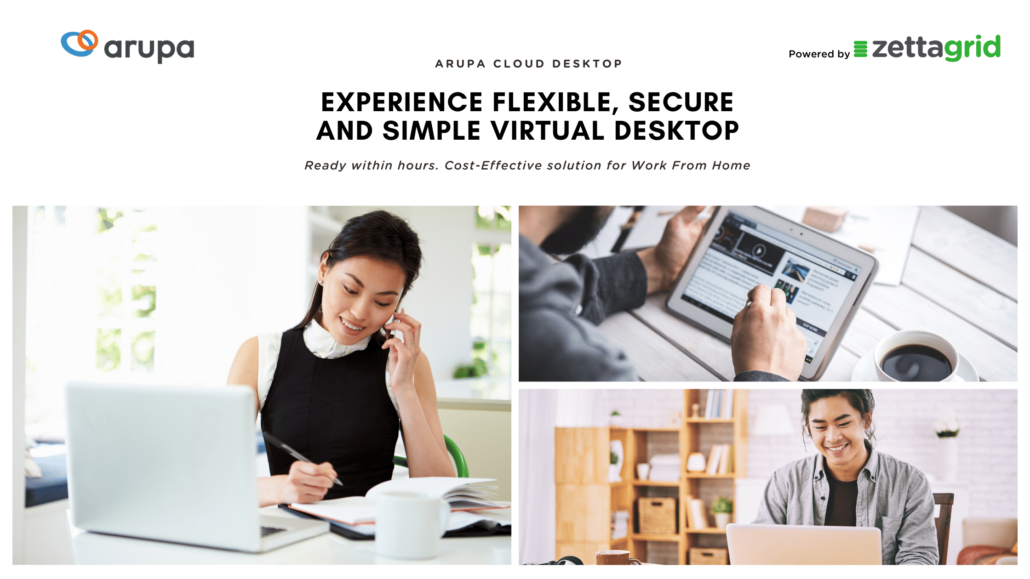
  1.     Virtual DesktopArupa Cloud Desktop WFH

Bekerja dari rumah (WFH) menjadi tantangan tersendiri bagi pelaku usaha. Pasalnya, bukan hanya device atau CPU yang terlalu besar untuk dibawa pulang karyawan, namun yang terpenting adalah keamanan data perusahaan saat mengakses aplikasi critical atau desktop dari luar kantor. Mengingat beberapa waktu lalu Badan Sandi Siber Negara (BSSN) meliputi 88 juta kasus kejahatan siber selama pandemi COVID-19. Untuk itu dibutuhkan solusi Virtual Desktop yang mudah digunakan dan pastinya dilengkapi dengan keamanan yang terjamin.

Arupa Cloud Desktop bisa menjadi pilihan bisnis di masa PSBB ini. Dengan memiliki kemampuan untuk mengoptimalisasi efisiensi IT, meningkatkan produktivitas user, serta memonitoring kegiatan user atau karyawan, pengusaha tidak perlu lagi khawatir dalam menjalankan usahanya di masa PSBB ini.

Tak hanya itu, Arupa Cloud Desktop menyediakan akses yang aman kepada karyawan untuk membuka data-data penting perusahaan pada aplikasi vital. Hal ini dikarenakan lapisan keamanan ACD yang setara dengan secure payment dan online banking.

Jika Anda ingin mengetahui lebih jauh mengenai Arupa Cloud Desktop, Anda bisa menghubungi kami di sini atau melalui tim kami di sales@zettagrid.id.

Migrating SAP To The Cloud How?

Migrating SAP To The Cloud

Mirating SAP to Cloud

Mirating SAP to Cloud

According to cbronline.com, System Application and Product in Data Processing (SAP) migration to the cloud has become a major concern for enterprises today. This can be happened as the end of support for SAP Business Suites approaches fast in 2025. That’s why, if company take a longer time to postpone the move to S/4HANA, the further it may be left behind by faster and savvier competitors.

But despite of that, some organizations still rely on SAP enterprise software to run their applications until now. Not only company will loss against its competitors, this method could also impact to a lot of costs, as traditional on-premise deployment is both expensive to maintain and difficult to manage. Therefore, migrating SAP to the cloud is one of the solution as it comes with a host of benefits, ranging from the lower TCO to faster product deployments, and more large-scale business transformations.

But, this migration process also need to be determined by some aspects. Therefore, we decided to made up a list on how to migrate SAP to the cloud. Read them below to help the organizations achieve a smoother migration.

  1.     Checking compatibility 

Checking the compatibility of your SAP applications, databases and operating system with the cloud service providers is a must. This first step will allow the providers to support your SAP upgrades as well. Besides, it will enable the company to analyze and adjust to the technical, language standards, and governance of the potential cloud provider to your company’s internal standard. So, the company will recognize if that IT provider has a good solutions to analyze the risks and ensure data safety.

  1.     Choose the Size of Storage

If your company aims to grow a business over a period of time, you need to consider what size of cloud storage for migrating SAP. By implementing the average utilization policy and get its exact size the company needs, its business will be helped to grow whenever necessary. 

  1.     Decide What Cloud Server’s Best Location 

Cloud servers could be located in any part of the world. Therefore, you must decide where its most appropriate location for your system to incurre costs of Wide Area Network (WAN). It can be started by knowing where the cloud providers located their data center. If your company found any providers servers and hosting applications had a closer location to your users, then it will enable them to have a great experience with your SAP.

  1.     Determine the Service You Need

Determining appropriate support for your SAP product is also necessary to be done. Therefore, you need to understand what service the company needs. Here we give you these three levels of service to choose:

  •  Entry-level.set (ES)

This first level is designed for disengaged ventures, small isolated work items, minimal SAP and database services intended for standalone SAP blueprints, training systems, demos, and so on. As it is entry level, most customers test new systems, create SAP demos, and conduct training programs.

  •   Development service (DS)

The second level is all about SAP and database support for development and quality assurance, ranging from development until it goes live. Usually, the cloud provider does it to support customers through the process of implementation, entire transition, to full service.

  • Full service (FS)

This full of support is designed to required for best system management. If the company need more support than one system landscape like in ES and DS, then this level of service might be the right one. Full service can be expanded to include language installations, SAP user administration, database refresh, and more. 

  1.     Planning and Budgeting 

Determining what to move first and what strategy to follow is important to make the migration as smooth as possible. Besides, it is a must to consider the testing costs. Therefore, assess the whole SAP landscape based on the data the company obtain is needed to draw up company budget on migrating SAP to the cloud. 

  1.     Testing 

If your company technologies and databases are running on a program that is not on the cloud, then it will need a changes to test those again. Although, this will take several times, yet it becomes an important step as it can contribute to the migrating SAP to the cloud and its final costs. 

  1.     Cleansing 

One of the biggest mistake in cloud migration would be the lack of consideration in how clean all files and data will be in the cloud. Therefore, before doing a migration, you need to clean the system of inconsistent and corrupted data, unreadable files, and other data that is unused. This aims to prevent process against bottlenecks. 

At Zettagrid, we could help you to reach your IT efficiency by migrating your SAP to the cloud. No worries, because Zettagrid already provides with layered firewall that of course it is very secure for your business. If you have further questions, you can contact us here or send us email to sales@zettagrid.id.