Posts

4 Reasons Why Many Businesses Adopt Hybrid Cloud

why hybrid cloud

4 Reasons Why Many Business Adopt Hybrid Cloud

Since the digital era began, many companies are relying on technology to automate their business. Ranging from scaling up IT capacity, collaborative work, data-sharing, and data storage, technology had helped business more efficient on their utility. No wonder many businesses now are on the race to digitally transform using technology. One of those such as Hybrid Cloud solutions.

As more organizations look to the public cloud to increase their data management capacity, hybrid cloud has often to be the solution of choice. With its agility and scalability, Hybrid Cloud offers enterprise efficient and flexible workloads. Therefore, it is not a surprise anymore to see this technology enables organizations to remain competitive while staying on budget.

Not only that, but this technology also brings a couple of things that can be another reasons for business to adopt. What are those? Read them below here:

1. The Hybrid Cloud Offers More Deployment For Business Needs

why hybrid cloud

(Source: NicoElNino from Getty Images Pro)

In maintaining IT environment, business storage certainly has its nuances. To operate better, business needs the operational flexibility to address them. But, no worries! Hybrid Cloud adoption can help business through the needs with more deployment options than other storage models.

As the comparison, for the on-premise component, business can only choose the options that range from zero-up-front cost software running on the business servers, to multi-petabyte turnkey system. Meanwhile, for the cloud component, a range of offerings could be long-term or short-term storage needs. Therefore, cloud storage enables business to mix and match the optimal solution. Whether it is for the rapid data access on-premises or long-term archival storage, these needs can be done by a common set of storage techniques and tools.

2. Hybrid Cloud offers better data protection strategy

why hybrid cloud

(Source: anyaberkut from Getty Images Pro)

Realize it or not, data protection is fundamental to every business storage. With the large data, applications, and systems it contained, business have to protect its storage so it could get off of the threats of data loss. Hybrid cloud storage model offers business of all sizes incredible data protection options, such as backup deployment.

With a hybrid configuration, you can backup data to object storage on premises, then automatically tier data to the cloud for long-term archive. 

In this way, business could have two optimal results: business have a copy of data on-site for rapid recovery and a low-cost, long-term archive offsite copy for disaster recovery.

3. Help business meet data governance rules 

why hybrid cloud

(Source: ipopba from Getty Images Pro)

Have you heard, external and internal data governance rules play a big part in data storage planning? According to Cloudian, business internal policy and external regulation required financial data and customer records management that subject to security, governance, and compliance rules. 

Luckily, Hybrid Cloud is here for us. With its model, business can more easily accommodate the changing needs. Not only that, but this technology can also set policies to ensure compliance tailoring migration and data protection rules to specific data types.

4. It delivers operational efficiency


(Source: designer491 from Getty Images)

Hybrid storage is one of the most scalable storage model for business needs. It combines local storage with cloud storage that is limitlessly scalable, for all practical purposes. Not only that, but its single-pool storage model reduces data silos, and simplifies management with a single namespace and a single view. Therefore, it is not surprising to see how hybrid can deliver business operational efficiency.

Those are four reasons why hybrid cloud adoption is implemented by many companies. But, how to adopt this solution for business?

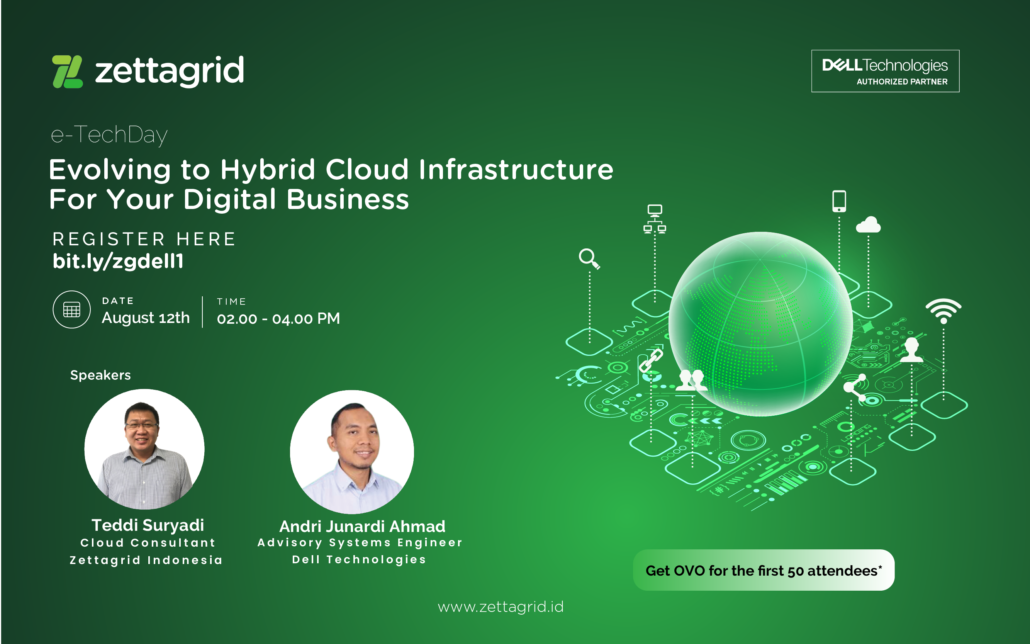
Find out more of these tips on Zettagrid e-Techday: Evolving to Hybrid Cloud Infrastructure for your Digital Business. Meet our expert Teddi Suryadi as Cloud Consultant Zettagrid Indonesia and Andri Junardi Ahmad as Advisory Systems Engineer South East Asia CI/HCI Presales Specialist, Dell Technologies, to learn about Hybrid Cloud adoption for your business needs.

Don’t miss this chance, register now here and win OVO for the first 50 registrants.


Evolving to Hybrid Cloud Infrastructure For Your Digital Business

evolving hybridEvolving to Hybrid Cloud Infrastructure For Your Digital Business

The race to digitally transform is underway and hybrid cloud solutions are a key enabler bringing digital innovation within reach of companies of all sizes and industries. With its agility and scalability, hybrid cloud offers to accommodate enterprises’ complex and varying workloads. Hybrid cloud approach also can significantly reduce capital expenditure and enable organizations to remain competitive while staying on budget.

How do you adopt a hybrid cloud approach for your business? Find the answer on “Zettagrid e-TechDay: Evolving to Hybrid Cloud Infrastructure For Your Digital Business”. Collaborate with Dell Technologies, meet and learn directly from our expert Teddi Suryadi as Cloud Consultant Zettagrid Indonesia and Andri Junardi Ahmad as Advisory Systems Engineer South East Asia CI/HCI Presales Specialist, Dell Technologies.

Event Details

Day: 12 August 2021
Time: 02.00 – 04.00 PM
Link to register: bit.ly/zgdell1
Live from Zoom Meeting

Agenda:

  • The Fastest Path to Hybrid Cloud for your Digital Business – Andri Junardi Ahmad as Advisory Systems Engineer South East Asia CI/HCI Presales Specialist, Dell Technologies.
  • Evolving to Hybrid Cloud For Your Digital Business – Teddi Suryadi as Cloud Consultant Zettagrid Indonesia.

Register now! FREE e-certificate and win OVO for the first 50 valid register.

3 Kiat Melindungi Data Bisnis dari Risiko Bencana

melindungi data bisnis

3 Kiat Melindungi Data Bisnis dari Risiko Bencana

Mungkin pepatah “Sedia payung sebelum hujan” sudah banyak Anda dengar di mana-mana. Baik untuk mempersiapkan kebutuhan maupun kegiatan sehari-hari, pepatah tersebut sering disematkan agar kita lebih bersiap menghadapi risiko kedepannya. Begitu pula ketika Anda membangun bisnis, pepatah ini bisa jadi acuan agar bisnis bersiap menghadapi ancaman yang potensial, termasuk salah satunya bencana.

Baru-baru ini, kebakaran telah terjadi di Kantor Badan Pengawas Obat dan Makanan (BPOM). Dilansir dari kompas.com, kebakaran bermula ketika kantor BPOM sedang ada perbaikan panel listrik di lorong F timur dan F barat. Meskipun kebakaran terjadi karena arus aliran pendek, namun CNN menyebut satu ruangan yang memuat arsip dan standardisasi napza rusak oleh kobaran api. Akibatnya, BPOM pun mengalami kerugian hingga Rp. 600 juta.

Kasus di atas mungkin bisa menjadi gambaran bagi organisasi untuk menghadapi bencana. Dengan mempersiapkan strategi keamanan data dan pemulihan bencana yang baik, bisnis bisa meminimalisir risiko atau kerugian yang mungkin terjadi.

Artikel ini akan memberikan Anda tips mempersiapkan pemulihan bencana yang baik untuk sistem IT bisnis. Penasaran seperti apa? Simak selengkapnya di bawah ini:

1. Menjaga tata kelola yang baik sesuai anjuran pemerintah

melindungi data bisnis

(Source: cyano66 from Getty Images Pro)

Tips pertama untuk melindungi data bisnis dari potensi bencana adalah dengan menjaga tata kelola yang baik sesuai anjuran pemerintah. Ini berarti organisasi dapat menyesuaikan regulasi infrastruktur IT-nya sesuai peraturan pemerintah yang ada. 

Bila menyangkut tentang perlindungan data dari bencana, bisnis bisa melihat ketentuan hukum Indonesia PP Nomor 71 tahun 2019, yang mewajibkan organisasi memiliki Disaster Recovery Center di Indonesia. Dengan mengimplementasikan peraturan tersebut, organisasi memiliki komitmen atas tata kelola yang baik atau good governance

2. Persiapkan solusi Disaster Recovery

melindungi data bisnis

(Source: Umnat Seebuaphans)

Bencana memang tidak bisa diprediksi kapan datangnya. Bisa jadi ketika bisnis sedang berkembang pesat, bencana datang dan mengganggu sistem IT dan menyebabkan downtime hingga hilangnya data. Oleh sebab itu, solusi pun diperlukan agar bisnis bisa mempersiapkan risiko bencana yang mungkin terjadi.

Memiliki solusi Disaster Recovery berbasis cloud bisa menjadi pilihan untuk melindungi sistem IT dan data bisnis Anda. Kemampuannya yang bisa meningkatkan penyimpanan sistem dan data, memudahkan bisnis untuk memiliki akses terhadap sistem dan datanya ketika bencana terjadi. Oleh sebab itu, Anda tidak perlu lagi khawatir ketika potensi dan risiko bencana melanda bisnis Anda.

 3. Persiapkan strategi untuk hadapi potensi downtime ketika bencana terjadi

melindungi data bisnis

(Source: ilkercelik from Getty Images Pro)

Ketika bencana terjadi dan menghambat sistem IT, ini bisa menimbulkan downtime untuk organisasi. Akibatnya, tidak hanya sistem IT yang akan terkendala, tapi layanan dan operasional bisnis pun bisa terhenti karena bencana. Apabila bisnis tidak mampu mengatasi kendala downtime, tentu ini bisa mengakibatkan kerugian secara finansial.

Itulah mengapa, solusi Disaster Recovery sangat penting untuk dimiliki bisnis. Selain mempersiapkan bisnis dari potensi bencana, Disaster Recovery juga memudahkan bisnis untuk memiliki ketersediaan akses ke sistem dan datanya. Sehingga ketika bisnis dihadapkan oleh potensi downtime akibat bencana maupun hardware failure, Disaster Recovery bisa memulihkan Virtual Machine (VM) sesuai dengan skenario failover bisnis. Dengan demikian, bisnis bisa meminimalisir risiko dan kerugian yang mungkin terjadi.

Itulah beberapa tips yang bisa Anda ikuti untuk melindungi data bisnis dari risiko bencana. Bila Anda memiliki pertanyaan lebih lanjut tentang solusi Disaster Recovery, Anda bisa menghubungi kami di sini atau ke sales@zettagrid.id.   


5 Serangan Siber Yang Perlu Bisnis Waspadai

serangan siber

5 Serangan Siber Yang Perlu Bisnis Waspadai

Saat mengembangkan bisnis, Anda pastinya telah memprediksi segala jenis ancaman dan potensinya terhadap keberlangsungan perusahaan. Mulai dari bencana alam, human error, hingga serangan siber, ketiganya memiliki potensi bahaya terhadap operasional bisnis. Terutama bila dikaitkan dengan kehilangan data perusahaan.

Di masa pandemi COVID-19 seperti sekarang, serangan siber menjadi ancaman paling tinggi untuk berbagai organisasi. Seiring banyaknya pengguna yang bekerja dan belajar dari rumah secara daring, pelaku serangan siber pun semakin gencar untuk melancarkan aksinya. Bahkan Cisco Umbrella pun melaporkan setidaknya terjadi peningkatan sebesar 40% serangan siber pada pandemi tahun lalu.

Melihat kasus ini, tentunya bisnis tidak hanya harus melindungi datanya. Mengenal segala jenis serangan siber juga perlu dilakukan agar strategi perlindungan data dapat dieksekusi tim IT dengan maksimal. Lalu jenis serangan siber apa saja yang perlu diwaspadai bisnis?

1. The Corporate Spies

serangan siber

(Source: South_agency from Getty Images Signature)

Banyak perusahaan melanggengkan jenis serangan siber The Corporate Spies untuk menyusup atau meretas sistem IT para pesaingnya. Dengan menggunakan peretas untuk melakukan spionase pada para pesaing bisnis, perusahaan bisa mencuri data penting pesaingnya seperti rencana bisnis, hak paten, data keuangan, kontrak, dan lainnya. Salah satu contoh kasus yang bisa diambil dari serangan siber satu ini adalah Compulife – NAAIP. 

Pada tahun 2020, Compulife Software, Inc. menuduh pesaingnya melakukan spionase untuk meretas dan mencuri data miliknya. Bukti juga menegaskan bahwa NAAIP menyewa seorang peretas untuk spionase perusahaan. Meski pengadilan kelas bawah memutuskan bahwa spionase tersebut tidak terhitung  sebagai kejahatan, Pengadilan Sirkuit justru tidak setuju dengan putusan tersebut dan memvonis NAAIP bersalah.

2. Nation-State Hackers

serangan siber

(Source: Wpadington from Getty Images)

Menurut Search Security, jenis serangan siber satu ini sering digunakan oleh pemerintah untuk meretas sistem maupun melakukan tindakan kejahatan terhadap rivalnya. Pernyataan tersebut dapat didasari ketika melihat serangan Solarwinds yang menyebabkan pelanggaran jaringan besar-besaran, hingga memungkinkan peretas untuk membocorkan ribuan data organisasi secara global, termasuk data pemerintah Amerika Serikat.  Lalu, bagaimana ini bisa terjadi?

Pada serangan siber tersebut, peretas memasang malware mereka ke SolarWinds, sebuah perusahaan yang memproduksi platform pemantauan kinerja IT yang disebut Orion. Perlu diketahui, ribuan perusahaan di seluruh dunia menggunakan perangkat lunak yang diproduksi oleh SolarWinds tersebut. Karena telah disusupi oleh malware, semua perangkat lunak dari pelanggan SolarWinds akhirnya tercemar pada bulan Maret hingga Juni 2020.

AS meyakini bila peristiwa tersebut terjadi karena ulah rusia. Tapi itu tidak sepenuhnya benar, ada juga kelompok peretas yang diduga memiliki hubungan dengan pemerintah Korea Utara dan Iran. 

3.  Script-Kiddies

serangan siber

(Source: kaptnali from Getty Images)

Meskipun dianggap amatir karena banyak meretas demi kesenangan, tapi Anda tidak boleh menganggap remeh serangan siber jenis Script-Kiddies. Serangan jenis satu ini cukup dikenal setelah memaksa ratusan website offline pada Jumat 2016 lalu. Bahkan, para ahli juga mempercayai bahwa Script-Kiddies sering membantu penjahat serius melalui penyelidikan sembrono dan kompromi sistem mereka.

Maka dari itu, Anda perlu berhati-hati agar bisnis dapat terlindungi dari serangan siber satu ini. Tapi, bagaimana caranya agar sistem IT terhindar dari serangan Script-Kiddies? Berikut tipsnya:

  • Perbarui perangkat lunak keamanan Anda secara teratur.
  • Lacak lalu lintas situs Anda secara teratur.
  • Jangan gunakan kata sandi yang lemah.

4. Cryptojackers

(Source: stevanovicigor from Getty Images Pro)

Cryptojackers merupakan jenis serangan siber yang mencuri daya komputasi dan sumber daya pengguna untuk meraup cryptocurrency. Dilansir MUO, McAfee pernah mengalami peningkatan 4000 persen dalam malware penambangan kripto pada 2019 lalu. Yang paling menakutkan, peretas beralih dari mengkompromikan PC pengguna individu dan perangkat seluler hingga menyusup ke situs web populer dan menyebarkan malware ke siapapun yang mengunjunginya.

Melihat kasus tersebut, Anda tentu perlu berhati-hati dalam melindungi data dan perangkat perusahaan. Maka dari itu, untuk meminimalisir potensi serangan cryptojackers, Anda bisa mengikuti tips berikut:

  • Selalu waspada terhadap perubahan perilaku perangkat Anda.
  • Gunakan selalu plugin, aplikasi, dan add on yang Anda kenal dan terpercaya.
  • Sebelum mengunduh aplikasi apapun, pastikan itu ditinjau dengan baik, diperbarui secara berkala, dan memiliki unduhan yang cukup.

5. Ransomware Sewaan

(Source: Zephyr18 from Getty Images Pro)

Banyak kelompok peretas terkenal di seluruh dunia menyediakan ransomware untuk disewakan. Kelompok-kelompok tersebut biasanya mengikuti model Ransomware as a Service (RaaS), di mana mereka menyewakan ransomware seperti pengembang perangkat lunak menyewakan produk Software as a Service (SaaS).

Salah satu yang cukup populer dari kasus ini adalah grup ransomware Darkside. Peretas tersebut menyerang Colonial Pipeline, sistem pipa minyak Amerika yang membawa bahan bakar jet dan bensin di sekitar AS. Akibat dari serangan siber tersebut, seluruh manajemen mengalami kerugian lebih dari $15 miliar.

Sebagai pengusaha, Anda pasti tidak ingin bisnis tertimpa ransomware seperti di atas bukan? Maka dari itu, strategi perlindungan data sangat penting untuk dimiliki oleh perusahaan, sehingga risiko kehilangan data bisa diminimalisir semaksimal mungkin. Lalu, bagaimana caranya agar bisnis mencapai strategi perlindungan data yang efektif untuk menghindari serangan siber? Ketahui tips selengkapnya dengan mengunjungi artikel ini.

Zettagrid Indonesia merupakan salah satu penyedia layanan cloud di Indonesia yang menyediakan Infrastructure as a Service (IaaS) seperti Virtual Data Center (VDC), Virtual Private Server (VPS), Backup as a Service (BaaS), Disaster Recovery as a Service (DRaaS), dan lainnya. Bila Anda memiliki pertanyaan tentang solusi atau keamanan cloud, Anda dapat menghubungi kami di sini atau ke sales@zettagrid.id.

2 Things To Know About Red Hat Enterprise Linux Subscription

red hat subscription2 Things To Know About Red Hat Enterprise Linux Subscription

As the digital era begins, IT infrastructure becomes a core business differentiator. Even to support business initiatives, IT organizations must optimize their infrastructure first. Therefore, it is not a surprise anymore to see many enterprises look for IT solutions to transform their business into digital. One of them is by using open source software like Red Hat Enterprise Linux subscription.

As an intelligent operating foundation for modern IT, Red Hat Enterprise Linux delivers optimal benefits for your organization. Its consistency across infrastructure allows business to deploy applications, workloads, and services using the same tools, regardless of location. Furthermore, a Red Hat Enterprise Linux subscription provides access to the resources, tools, and technologies business needs to be successful. That’s why, this open source software is often to be the option whether for hybrid cloud deployment or local premise.

Then, what is the difference between Red Hat Enterprise Linux subscription through Cloud Service Provider (CSP) and Red Hat for Hybrid Cloud Deployment and On-Premise? in Zettagrid e-TechDay vol. 10, Muhammad Yunus as a Presales Engineer Manager at Zettagrid Indonesia and Wisa Prabowo as Solution Architect at Red Hat, have answered this question. Curious to know the recap? Read them below here:

Different Support Team Services

CSP does not only offers IT infrastructure, but service like support team is also available for its customers. Therefore, if your business plan to subscribe to Red Hat Enterprise Linux whether for Hybrid Cloud Deployment or On-Premise through CSP like Zettagrid, the support team services will also be available for it. 

However, the services will be different from the business subscription needs. If the business plan to subscribe the Open Sources for local premise through Zettagrid, its sub-support will be available for it. Then, if the business plan for implementing it on hybrid cloud deployment, the support team services will be available in premium. This means, its support team services will be available according to its SLA.

Same as CSP, Red Hat also provides Support Team as a service for Business’ Red Hat Enterprise Linux Subscription. With the standard service, its support team will be available for a year. So, if the business plan to subscribe to its open source through Red Hat, all services will be handled by Red Hat.

Cost and Flexibility

If your business ever explored CSP, management must have known the pay-per-use concept. Yes, with the pay-per-use, business could manage its cost for the cloud infrastructure. So is the Open Source like Red Hat Enterprise Linux subscription, business could have its pay-per-use if they subscribe it through CSP like Zettagrid Indonesia.

However, if your business plan to subscribe through Red Hat, pay-per-use is not available for it. Red Hat offers a subscription in standard and premium for business, and both are available for a year subscription only. 

Find out more about this session by watching the webinar again on our Youtube account. And if you are interested in our cloud solutions, you can contact us at sales@zettagrid.id or click here.

4 Benefits of AI in Cloud Computing

AI in cloud

4 Benefits of AI in Cloud Computing

 In this modern era, digital technology like Artificial Intelligence (AI) has become one of the solutions to boost the development of various industries. With its capability to automate business or even its operations, AI is believed to be the technology that increases company productivity. Therefore, it is not a surprise anymore to see the market of AI in the oil and gas industry predicted to reach US 3,81 Billion Dollars, with a CAGR of 10,96% for 2020-2025.

However, developing AI systems requires large data sets. If the organization only relies on the local premise, AI deployment will result in a big investment and inefficiency considering the On-Premise will need maintenance. That’s why before AI development is going further, organizations need to look for an efficient solution. One of them is by implementing Cloud Computing.

The combination of AI and Cloud Computing results in an extensive network capable of holding massive volumes of data, while continuously learning and improving. Hence, both assist in the automation of routine activities within IT infrastructure and result in IT efficiency.

Not only that but developing AI in Cloud Computing also has benefits for the organization. All of them can be seen below here:

1. Automate the workflow

AI in cloud

(Source: Wright Studio from Shutterstock)

Running IT resources and business operations at the same time can be overwhelming for some organizations. Even if it’s also implemented AI, a business can find it difficult to manage its workflow and IT efficiency. But no worries, as long as Cloud Computing can be used for AI, the organization can pass the challenge and achieve maximum productivity.

AI can automate complex and repetitive tasks to boost productivity and perform data analysis without any human intervention. So, when the organization develops AI in Cloud Computing, the IT team can focus on strategic operations while AI performs regular tasks. Hence, the organization can be more efficient, strategic, and insight-driven.

2. Maintain organizations data management

(Source: Alexander Supertramp from Shutterstock)

Besides increasing efficiency and flexibility, developing AI in Cloud Computing would also play a significant role in processing, managing, and structuring data.

By using cloud for AI, organization can boost marketing, customer care, and supply chain data management with more reliable real-time data. AI tools streamline how data is ingested, modified, and managed. For example, organization can deploy AI tools into Zettagrid Indonesia cloud to get real-time personalization, detect cyber threats, and maintenance scenarios.

3. Deeper Insights

AI in cloud

(Source: NicoElNino from Shutterstock)

Developing AI in Cloud Computing can identify patterns and trends in vast data sets. It uses historical data and compares it to the most recent data, which provides IT teams with well-informed, data-backed intelligence.

On top of that, using cloud computing for AI tools can also perform data analysis fast so organizations can rapidly and efficiently address customer queries and issues. The observations and valuable advice gained from AI capabilities result in quicker and more accurate results. Therefore, the cloud is efficient for business continuity.

4. Lowering costs

AI in cloud

(Source: Palto from Shutterstock)

A big advantage of Cloud Computing is that it eliminates costs related to on-site data centers, such as hardware and maintenance. Those upfront costs can be prohibitive with AI projects, but in the cloud enterprises can instantly access these tools for a monthly fee making research and development-related costs more manageable. Additionally, AI in cloud can gain insights from the data and analyze it without human intervention. That’s why, it is more efficient not only in cost but also in human resources.


Zettagrid Indonesia is a Cloud Service Provider in Indonesia that provides Infrastructure as a Service (IaaS) such as VMware Virtual Data Center, VMware Virtual Server, Veeam Backup, and so on. If you have any questions related to our cloud solutions for AI, you can reach us here or through sales@zettagrid.id.


Strategi Backup 3-2-1 Untuk Perlindungan Data

strategi backup 3-2-1Strategi Backup 3-2-1 Untuk Perlindungan Data

Di era digital seperti sekarang ini, kebutuhan mem-backup data bukan lagi hal yang baru untuk dilakukan oleh organisasi. Seiring dengan data yang kian bertambah setiap harinya, strategi perlindungan data seperti Backup pun semakin diminati dan diimplementasikan oleh berbagai bisnis untuk mengantisipasi terjadinya kehilangan data. Salah satu contohnya adalah strategi Backup 3-2-1.

Secara praktik, strategi Backup 3-2-1 bertujuan untuk menyalin dan menyimpan data di beberapa medium yang berbeda. Dengan cara tersebut, bisnis diharapkan bisa menyelamatkan datanya apabila terjadi human error ataupun bencana alam yang dapat berdampak pada kehilangan data. Kemudian, bagaimana cara untuk mulai mengimplementasikan strategi satu ini?

Mengenal Strategi Backup 3-2-1

Menurut backblaze.com, strategi Backup 3-2-1 berarti memiliki setidaknya tiga salinan dari total data Anda, dengan dua di antaranya ditempatkan secara lokal tetapi pada media yang berbeda, sedangkan satu salinan data di tempatkan di offsite. Sebagai contoh, mari kita coba menggunakan “data penjualan bisnis” Anda sebagai skenario strategi pencadangan data ini.

Dalam komputer pribadi Anda, tersimpan data penjualan bisnis yang sering diperbarui setiap minggunya. Data yang tersimpan tersebut merupakan data pertama yang perlu di-Backup di medium berbeda. Untuk mengakalinya, Anda menggunakan external Hard-Drive untuk menyimpan salinan kedua dari data penjualan bisnis Anda. Tak tanggung-tanggung, Anda juga menggunakan solusi Backup seperti Cloud Backup sebagai offsite untuk menyimpan salinan ketiga dari data penjualan bisnis Anda. Dengan demikian, salinan data ketiga yang terletak di offsite tersebut akan disimpan di data center.

Mengapa dua disimpan di lokal dan satu di Offsite?

Apapun perangkat yang Anda miliki, on-site Backup merupakan cara paling cepat dan mudah untuk mengakses data ketika sesuatu terjadi pada perangkat Anda. Jadi ketika laptop atau komputer Anda mengalami kerusakan, Anda masih memiliki external hard drive untuk mendapatkan kembali data Anda.  

Meskipun memiliki on-site Backup seperti contoh di atas merupakan awal yang baik, tetapi memiliki offsite Backup adalah komponen kunci dalam strategi Backup 3-2-1. Cadangan di on-site memang mudah diatur, namun sayangnya salinan data Anda tersebut rentan mengalami kehilangan jika terjadi pencurian, banjir, kebakaran, dan kejadian tidak terduga lainnya.

Apakah solusi Cloud merupakan medium yang sempurna?

Sesuai dengan kemampuannya yang fleksibel, cloud bisa menjadi pendekatan paling mumpuni untuk memulai strategi Backup 3-2-1. Dengan mereplikasi data Anda dan menyimpannya di data center lain, Anda bisa mendapatkan ketenangan dan dengan mudah mencadangkan data Anda kapan saja secara otomatis.

Dengan Arupa Object Storage Anda dapat menyimpan data backup hingga bilangan petabyte dengan lebih fleksibel di offsite sehingga memenuhi kebutuhan Backup 3-2-1 Anda. Jika Anda sekarang sudah menggunakan NAS ataupun solusi pencadangan data di perusahaan Anda, kami dapat membantu Anda untuk mencapai strategi Backup 3-2-1.


Zettagrid Indonesia merupakan penyedia layanan Cloud Computing Indonesia yang menyediakan solusi IaaS seperti Virtual Data Center (VDC), Virtual Private Server (VPS), Backup as a Service (BaaS), Disaster Recovery as a Service (DRaaS), dan Object Storage as a Service (OSaaS). Jika Anda memiliki pertanyaan lebih lanjut tentang solusi cloud kami, Anda dapat menghubungi kami di sini atau ke sales@zettagrid.id.
Tertarik untuk mengenal solusi Object Storage? Baca produk kami selengkapnya di sini.


Drive Business Innovation With The Cloud

drive business with cloudDrive Business Innovation With The Cloud

Many businesses currently rely on the cloud solely to save money or add simple mobility, but these organizations are hardly scratching the surface of the cloud’s true capabilities. Cloud Computing offers countless opportunities to drive business innovation, and it’s time for the business world to take advantage of this.

Zettagrid Indonesia with Dell Technologies invites you to hear what Pajak.io and PT. IndoSterling Aset Manajemen said about how cloud computing could drive its business innovation and their experiences also tips to maximize the usage of cloud computing. Meet Arif Darmawan as ISV and CSP Lead Dell Technologies, Jefriansyah Hertikawan as CTO & Co Founder of Pajak.io, also Supriadi as IT Coordinantor PT. IndoSterling Aset Manajemen on Zettagrid e-CloudTalk vol.06: Drive Business Innovation With The Cloud”:


Event Details:
Date: Thursday, 24 June 2021
Time: 02.00 – 04.00 PM
Where: Zoom Meetings


Event Agenda:

  • Building a Better Cloud Begins with Better Infrastructure – Arif Darmawan, ISV & CSP Lead DELL Technologies Indonesia.
  • Sharing experiences and live talkshow with guest speakers

Register now and get chance to win FOLDABLE BIKE and SMARTWATCHES also get a chance to win shopping vouchers at the end of the event.

What To Prevent In Migrating To Cloud? 

migrating to cloudWhat To Prevent In Migrating To Cloud? 

In expanding business systems, enterprise often look for the best asset for integration. Technology such as Cloud Service Provider can be an option for business integration systems. Not only because it’s affordable, but it also can be allocated and changed in minutes. Even enterprises technology elites are spending dollars on the Public Cloud these days. Thus, it can be a good idea for a business long-term investment.

However, implementing cloud infrastructure can’t be defined as a solution to fix existing problems, such as data mess, application issues, inadequate security, or frequent outages due to a lack of operational disciplines and tools. Once business migrates these issues, it will end up with less-than-optimal systems in the cloud. Moreover, it can get worse if the IT department still be on the learning curve of using the Public Cloud. So, it will be increasing risk and cost without improving any of its systems.

Therefore, business needs to know what mistakes in migrating to the cloud. No worries, below here we have compiled three things that needed to avoid in cloud migration. Read them below here:

1. Migrating all business data to the cloud

migrating to cloud

(Source: jirsak from Getty Images)

In developing a business, having multiple sources is important for storing enterprise data. But if you don’t look at this side, then you just make a big mistake for business continuity.

Having a massive number of redundant databases and no one knows where all the data is, can be fatal for the business. Moreover, if the business decided to migrate all data – including the complex one – to the cloud, it will not improve everything except for causing a new problem. Therefore, consider and segmented what to store and integrated into the cloud is important to do. Thus, business investment in cloud infrastructure can be effective and beneficial.

2. Forget to secure the data

migrating to cloud

(Source: stevanovicigor from Getty Images)

Migrating certain data to cloud infrastructure must include proper security practices from the organization. Even, a change is needed once the data move. But, if your organization does no comply with this practice, then you just caused a new problem for cloud migration.

As migrating encrypted data to the cloud, the organization certainly thinks if the assets are normally well-locked down. Little did they know, it is easy to inadvertently create vulnerabilities in the cloud since customers are responsible for setting many security controls around their apps and data. That’s why securing the data by encrypting them is important for the organization before it is being moved to the cloud.

3.  Assuming that all cloud environments are the same

(Source: Denis Isakov from Getty Images Pro)

Once business decided to migrate their system to cloud, they can’t assume that all cloud environments are the same. Every cloud provider designs their cloud differently, specializing in different functions and capabilities for their deployment.

That’s why in migrating to cloud, business should never blindly do it from one cloud to another before becoming familiar with its new environment. Otherwise, the migration process will be a problem while organization needs to struggle to reconfigure data to fit the new environment.

Zettagrid Indonesia is a Cloud Service Provider in Indonesia that provides Infrastructure as a Service (IaaS) such as VMware Virtual Data Center, VMware Virtual Server, Veeam Backup, and so on. If you have any questions related to the effective backup strategy or cloud solutions, you can reach us here or through sales@zettagrid.id.


Try This 4 Steps To The Effective Backup Strategy

effective backup strategyTry This 4 Steps To The Effective Backup Strategy

In managing a business, enterprises certainly think that data is the key to its success. Along with the record of data that is collected and increasing by the day, enterprise can optimize and grow their business in a better way. That’s why the availability of data must be kept and protected to prevent its loss.

Building a backup strategy can be one of the options that give enterprise peace of mind. By having the copy of data or its backup, enterprise don’t have to worry more if threats like human errors, overwritten data, and even ransomware strike business systems.

Additionally, backing up business data will also let the business get back up and running after its end-point protection software got breached. In this case, ransomware even required an effective backup strategy to defeat. Therefore, having a very current backup of everything located off-site with effective security can help to defeat ransomware easier.

This article has listed four steps to help enterprise build effective backup strategy. Read them below here:

1. Create Multiple Copies

effective backup strategy

(Source: alengo from Getty Images Signature)

When we talk about data backup, business needs to create multiple copies in multiple areas. In this case, enterprise can implement the 3-2-1 rule for backup to protect its data. But, what is the 3-2-1 rule?

The 3-2-1 rule was stated by US photographer Peter Krogh while writing a book about digital asset management. Here’s the recap:

  • Three: Three copies of business data should be maintained. One is the original or production copy, then the two are the backup copies. All copies contain the same data from the same point in time. This method aims to save at least one copy of data once the others fail or disappear.
  • Two: Two copies of business data exist on media that are separate from one another, even if those are in the same geographic location. For example, one copy on a server, and the other would be on an external hard disk.
  • One: One data copy exists in an offsite location. This could be in another office, data center, or in the cloud.

2. Implement Your Backup on Public Cloud

effective backup strategy

(Source: model-la from Getty Images)

As the previous point before, physical storage is not enough to protect business data from threats. Therefore modern alternatives are needed by enterprises for optimizing the data protection strategy. One of them is by implementing backup on Public Cloud Service Provider.

Numerous Cloud Service Providers offer Backup-as-a-Service (BaaS) for business. That way, a business can be able to protect its data by provision and run its backup from Public Cloud infrastructure. Furthermore, the BaaS is even simpler than other software, because there are no operating systems or hardware to configure by the business.

3. Engage Services that Focus on Data Safety

(Source: jirsak from Getty Images)

The cloud has become a fantastic aid to companies looking to quickly and easily implement a reliable backup strategy. Prices are low, standards are open, not proprietary, on-site hardware is also low or even nonexistent, and your data can be accessed or fully restored from practically anywhere. That’s why its services are beneficial for business. 

However, using a cloud service provider for the effective backup strategy also includes a Service Level Agreements (SLA), which details what security measures are being used and how it is enforced. That’s why business needs to identify what security features that provider can offer based on its SLA. 

Not only that but security certifications like ISO27001, ISO9001, and PCI DSS are also needed to be considered in looking for a provider. That way, business would know that the provider has a guarantee in securing its client’s data.

4. Automate Your Backups

effective backup strategy

(Source: 5432action from Getty Images)

Backing up data manually every time there’s a concern can be troublesome for business. Especially, when business doesn’t acknowledge how to set automatic constant data backup. It would be a problem not only for the business operation but also for its services when disaster occurred.

That’s why setting and scheduling automatic backups on a constant and recurring basis is needed. So, business don’t have to worry more if disaster occurs, because this backup strategy has been prepared to replicate business data regularly.  


Zettagrid Indonesia is a Cloud Service Provider in Indonesia that provides Infrastructure as a Service (IaaS) such as VMware Virtual Data Center, VMware Virtual Server, Veeam Backup, and so on. If you have any questions related to the effective backup strategy or cloud solutions, you can reach us here or through sales@zettagrid.id.