Posts

4 Reasons Why Many Businesses Adopt Hybrid Cloud

why hybrid cloud

4 Reasons Why Many Business Adopt Hybrid Cloud

Since the digital era began, many companies are relying on technology to automate their business. Ranging from scaling up IT capacity, collaborative work, data-sharing, and data storage, technology had helped business more efficient on their utility. No wonder many businesses now are on the race to digitally transform using technology. One of those such as Hybrid Cloud solutions.

As more organizations look to the public cloud to increase their data management capacity, hybrid cloud has often to be the solution of choice. With its agility and scalability, Hybrid Cloud offers enterprise efficient and flexible workloads. Therefore, it is not a surprise anymore to see this technology enables organizations to remain competitive while staying on budget.

Not only that, but this technology also brings a couple of things that can be another reasons for business to adopt. What are those? Read them below here:

1. The Hybrid Cloud Offers More Deployment For Business Needs

why hybrid cloud

(Source: NicoElNino from Getty Images Pro)

In maintaining IT environment, business storage certainly has its nuances. To operate better, business needs the operational flexibility to address them. But, no worries! Hybrid Cloud adoption can help business through the needs with more deployment options than other storage models.

As the comparison, for the on-premise component, business can only choose the options that range from zero-up-front cost software running on the business servers, to multi-petabyte turnkey system. Meanwhile, for the cloud component, a range of offerings could be long-term or short-term storage needs. Therefore, cloud storage enables business to mix and match the optimal solution. Whether it is for the rapid data access on-premises or long-term archival storage, these needs can be done by a common set of storage techniques and tools.

2. Hybrid Cloud offers better data protection strategy

why hybrid cloud

(Source: anyaberkut from Getty Images Pro)

Realize it or not, data protection is fundamental to every business storage. With the large data, applications, and systems it contained, business have to protect its storage so it could get off of the threats of data loss. Hybrid cloud storage model offers business of all sizes incredible data protection options, such as backup deployment.

With a hybrid configuration, you can backup data to object storage on premises, then automatically tier data to the cloud for long-term archive. 

In this way, business could have two optimal results: business have a copy of data on-site for rapid recovery and a low-cost, long-term archive offsite copy for disaster recovery.

3. Help business meet data governance rules 

why hybrid cloud

(Source: ipopba from Getty Images Pro)

Have you heard, external and internal data governance rules play a big part in data storage planning? According to Cloudian, business internal policy and external regulation required financial data and customer records management that subject to security, governance, and compliance rules. 

Luckily, Hybrid Cloud is here for us. With its model, business can more easily accommodate the changing needs. Not only that, but this technology can also set policies to ensure compliance tailoring migration and data protection rules to specific data types.

4. It delivers operational efficiency


(Source: designer491 from Getty Images)

Hybrid storage is one of the most scalable storage model for business needs. It combines local storage with cloud storage that is limitlessly scalable, for all practical purposes. Not only that, but its single-pool storage model reduces data silos, and simplifies management with a single namespace and a single view. Therefore, it is not surprising to see how hybrid can deliver business operational efficiency.

Those are four reasons why hybrid cloud adoption is implemented by many companies. But, how to adopt this solution for business?

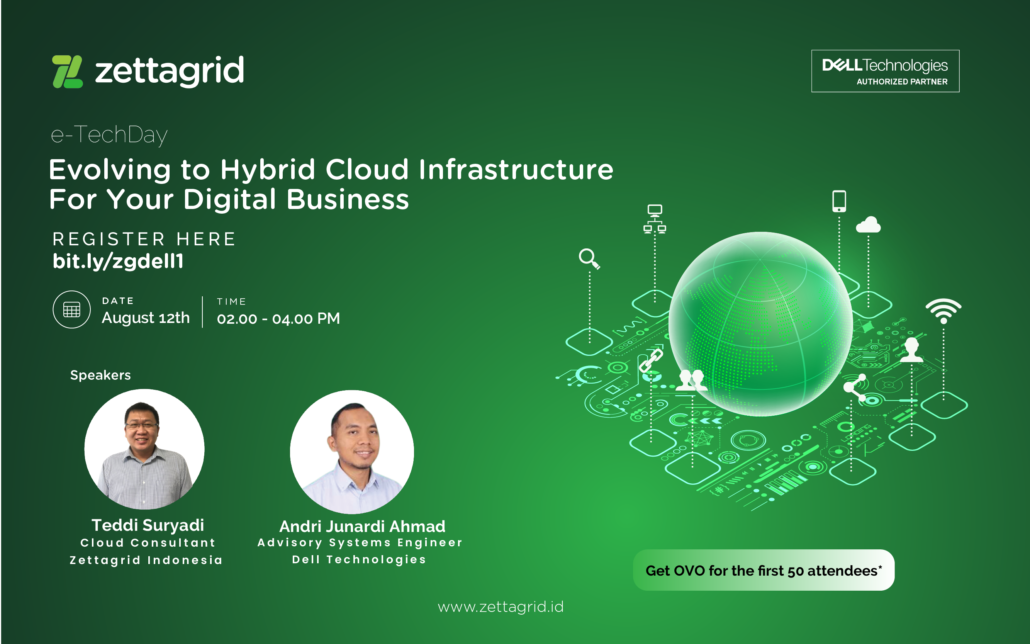
Find out more of these tips on Zettagrid e-Techday: Evolving to Hybrid Cloud Infrastructure for your Digital Business. Meet our expert Teddi Suryadi as Cloud Consultant Zettagrid Indonesia and Andri Junardi Ahmad as Advisory Systems Engineer South East Asia CI/HCI Presales Specialist, Dell Technologies, to learn about Hybrid Cloud adoption for your business needs.

Don’t miss this chance, register now here and win OVO for the first 50 registrants.


Evolving to Hybrid Cloud Infrastructure For Your Digital Business

evolving hybridEvolving to Hybrid Cloud Infrastructure For Your Digital Business

The race to digitally transform is underway and hybrid cloud solutions are a key enabler bringing digital innovation within reach of companies of all sizes and industries. With its agility and scalability, hybrid cloud offers to accommodate enterprises’ complex and varying workloads. Hybrid cloud approach also can significantly reduce capital expenditure and enable organizations to remain competitive while staying on budget.

How do you adopt a hybrid cloud approach for your business? Find the answer on “Zettagrid e-TechDay: Evolving to Hybrid Cloud Infrastructure For Your Digital Business”. Collaborate with Dell Technologies, meet and learn directly from our expert Teddi Suryadi as Cloud Consultant Zettagrid Indonesia and Andri Junardi Ahmad as Advisory Systems Engineer South East Asia CI/HCI Presales Specialist, Dell Technologies.

Event Details

Day: 12 August 2021
Time: 02.00 – 04.00 PM
Link to register: bit.ly/zgdell1
Live from Zoom Meeting

Agenda:

  • The Fastest Path to Hybrid Cloud for your Digital Business – Andri Junardi Ahmad as Advisory Systems Engineer South East Asia CI/HCI Presales Specialist, Dell Technologies.
  • Evolving to Hybrid Cloud For Your Digital Business – Teddi Suryadi as Cloud Consultant Zettagrid Indonesia.

Register now! FREE e-certificate and win OVO for the first 50 valid register.

3 Tips to Successful Hybrid Cloud Management

successful hybrid cloud

3 Tips to Successful Hybrid Cloud Management

In this modern era, data becomes one of the critical assets that can drive business. The velocity at which it is being generated and the volume of data collected by the business are increasing and accelerating by the day. Even, IDC’s research estimates that 463 exabytes of data will be generated every day by 2025. With this volume, can you imagine how big the challenge can be for storing a company’s data?

Traditional storage is not enough to store the growing volume of data since maintenance and hardware investment are often needed to optimize its capacity. That’s why a solution is needed by enterprise in managing the system and data flexibly in store. One of them is by implementing a successful Hybrid Cloud strategy.

However, planning and preparing for data management in the Hybrid Cloud only is not enough. Some key aspects also have to keep operating to achieve the maximum data management in Hybrid Cloud. In this article, we have compiled three things to successful Hybrid Cloud management. Curious to know how? Check them below here:

1. Identify How it Works

(Source: katemangostar from Freepik)

Once you know Hybrid Cloud can be a solution to your data management, you need to understand how it works. This not only includes finding good tools, but it also involves strategies.

The first step is to understand what you need to manage are:

  • Verifying the applications involved and what they do
  • Gaining visibility into the way users interact with the applications
  • Understanding the criticality of the workloads to the business
  • Identifying who owns the workloads
  • Confirming where workloads run 

2. Monitor the Hybrid Cloud Security Provider

(Source: rvlsoft from Getty Images)

In simplifying data management in Hybrid Cloud environment, business also needs to understand the requirements for security and governance. Hybrid Cloud security needs to be a focus from the start, and mechanisms like identity and access management (IAM) make it simpler by giving business ways to assign the identities to servers, people, devices, and data. Thus, it would be easy to manage the access. Not only that but the security also requires encryption for all information, both when it’s at rest and when it’s in use.

Additionally, Service Level Agreements (SLA) also need to be considered as part of the successful Hybrid Cloud management. SLAs are contracted promising specific levels of service to the end-user, with penalties if those levels aren’t met. Knowing those promises is an essential part of making sure the hybrid cloud manager meets expectations.

3. Determine Tools to Support Hybrid Cloud

(Source: Natali_Miz from Getty Images)

The additional key to effective data management is by choosing from the many hybrid cloud management tools. This can be concluded either as a solution or a consolidated hybrid cloud management platform.

The tools to support a successful Hybrid Cloud also cover many areas, such as performance management, resource management, security management, and network management. The capabilities to look for in these types of solutions can be:

  • Having a unified view of all the cloud environments, including what applications and services are running.
  • Providing alerts and actionable data to help streamline workloads.
  • Delivering seamless service to end-users.

Those are some tips that you can implement to build successful Hybrid Cloud management. If you have any questions related to Hybrid Cloud solutions, you can contact us here.


Zettagrid Indonesia is a Cloud Service Provider in Indonesia that provides Infrastructure as a Service (IaaS) such as VMware Virtual Data Center, VMware Virtual Server, Veeam Backup, and so on. If you have any questions related to our solution, you can reach us here or through sales@zettagrid.id.

Ingin Membangun Strategi Hybrid Cloud? Lakukan 5 Langkah Ini!

Strategi Hybrid Cloud

Ingin Membangun Strategi Hybrid Cloud? Lakukan 5 Langkah Ini!

Perkembangan teknologi seperti pemanfaatan Cloud Computing memang tidak diragukan lagi pengaruhnya. Selain karena membuat operasional bisnis berjalan secara efisien, cloud nyatanya juga menghasilkan beragam inovasi baru bagi berbagai perusahaan. Tak heran karena kecanggihan dan agilitas yang diberikan ini, Gartner memprediksikan 75% perusahaan besar dan menengah  akan mengadopsi strategi cloud, termasuk strategi Hybrid Cloud sebagai salah satunya.

Di masa kini, strategi Hybrid Cloud bukan lagi menjadi opsi Cloud Computing terbaru untuk diimplementasikan oleh bisnis. IBM bahkan berpendapat bahwa Hybrid Cloud menjadi salah satu solusi yang menarik untuk diterapkan, mengingat kapasitasnya yang memungkinkan pengusaha untuk memanfaatkan penyedia layanan Public Cloud dan menggunakan Private Cloud untuk keperluan aplikasi dan datanya.

Tak hanya itu, pemanfaatannya pun juga dapat mengombinasikan proses pengolahan data dengan menggunakan Cloud Computing dan olah data secara langsung di data center perusahaan. Dengan demikian, perusahaan akan memiliki sistem pengolahan data yang mendekati real-time, bebas anggaran, dan skalabilitas yang tinggi.

Akan tetapi, membangun strategi Hybrid Cloud juga tidak bisa dilakukan secara sembarang. Beberapa hal juga perlu dipertimbangkan untuk mendapatkan keuntungan yang optimal. Di artikel kali ini, Zettagrid merangkum langkah-langkah yang perlu bisnis perhatikan untuk menciptakan strategi Hybrid Cloud. Ingin tahu seperti apa? Simak selengkapnya di bawah ini:

1. Teliti Opsi Penyedia Layanan dan Lakukan Uji Coba

Saat berencana mengimplementasikan strategi Hybrid Cloud, Anda pastinya akan memanfaatkan satu atau beberapa penyedia layanan Public Cloud. Untuk menentukan yang sesuai, ada baiknya bisnis tidak hanya menyelami atau memilih salah satu penyedia layanan Public Cloud.

Cobalah untuk menginvestasikan waktu dan sumber daya bisnis demi menemukan penyedia layanan Public Cloud yang sesuai. Dengan menilai secara keseluruhan terkait performa dan layanan yang ditawarkan masing-masing penyedia, ini akan mengerucutkan penyedia layanan yang sesuai untuk strategi Hybrid Cloud bisnis Anda.

2. Pilih Strategi Penskalaan

Ketika menerapkan strategi Hybrid Cloud, memperluas kemampuan IT bisnis dengan menyediakan lebih banyak sumber daya dari penyedia layanan Public Cloud, sudah pasti dilakukan oleh perusahaan. Maka, ketika Private Cloud juga perlu diskalakan untuk mencapai strategi Hybrid Cloud yang optimal, penskalaan yang tepat juga perlu dilakukan oleh perusahaan.

Anda bisa memutuskan strategi penskalaan yang sesuai dan mencakup faktor-faktor seperti anggaran, sensitivitas data, dan kontrol yang Anda perlukan atas aplikasi yang Anda skalakan. Sehingga, ini akan menentukan apakah Anda perlu menskalakan data atau aplikasi tertentu ke Public Cloud atau Private Cloud.

3. Tentukan Sistem yang Akan Digunakan di Hybrid Cloud

Pada umumnya, menggunakan Hybrid Cloud bertujuan untuk mengurangi beban pada sistem di infrastruktur lokal dan mengurangi biaya IT bisnis. Untuk mencapai hal tersebut, maka akan masuk akal bagi bisnis untuk merencanakan dan menyegmentasikan sistem dan aplikasi yang akan digunakan di layanan Public Cloud.

Sistem dan aplikasi yang akan digunakan di strategi Hybrid Cloud juga tidak bisa diimplementasikan secara sembarang. Anda perlu menentukan sistem yang sesuai untuk digunakan di Public Cloud. Misalnya, Anda menggunakan strategi Hybrid Cloud untuk kebutuhan pengembangan, Backup, atau Disaster Recovery.

4. Melakukan Implementasi Secara Bertahap

Perlu diketahui, mengimplementasikan sistem dan aplikasi ke Hybrid Cloud bukan berarti Anda dapat melakukannya sekaligus. Waktu dan berbagai tahap implementasi juga diperlukan oleh bisnis agar strategi Hybrid Cloud dapat berjalan sesuai keinginan. Lalu bagaimana caranya?

Pertama-tama, bisnis perlu mengidentifikasi proses, aplikasi, atau beban kerja apapun yang dapat diimplementasikan dengan mudah ke sistem Public Cloud. Beban kerja awal ini dapat bertindak sebagai percobaan implementasi, sehingga perusahaan berkesempatan untuk mengetahui lebih banyak tentang seluk-beluk implementasi sistem di cloud yang lebih kecil sebelum menangani yang lebih besar. 

Selain itu, Anda juga perlu memeriksa dampak aplikasi di setiap fase implementasi. Sehingga Anda dapat mengetahui aplikasi mana yang perlu diperbarui sebelum atau selama proses implementasi. 

5. Teliti Persyaratan Kepatuhan Penyedia Layanan

Penting bagi Anda untuk memiliki pemahaman penuh tentang persyaratan kepatuhan sebelum menggunakan layanan Public Cloud. Jika bisnis Anda berencana untuk menggunakan penyedia layanan cloud, Anda perlu memastikan apakah penyedia tersebut memiliki sertifikasi keamanan data dan informasi untuk melindungi data perusahaan.

Zettagrid Indonesia sebagai penyedia layanan cloud memiliki aturan kepatuhan seperti ISO27001, ISO9001, dan PCI DSS untuk melindungi data bisnis dan informasi perusahaan yang tersimpan. Dengan adanya aturan ini, maka kebocoran data dan informasi bisnis dapat diminimalisir oleh penyedia layanan cloud. Sehingga ini akan mengoptimalkan strategi Hybrid Cloud Anda dengan lebih aman. 


Zettagrid Indonesia merupakan penyedia layanan cloud Indonesia yang menawarkan layanan Infrastructure as a Service (IaaS). Jika Anda memiliki pertanyaan lebih lanjut tentang solusi cloud kami, Anda bisa menghubungi kami di sini atau ke sales@zettagrid.id.